Free tools · Working days calculator
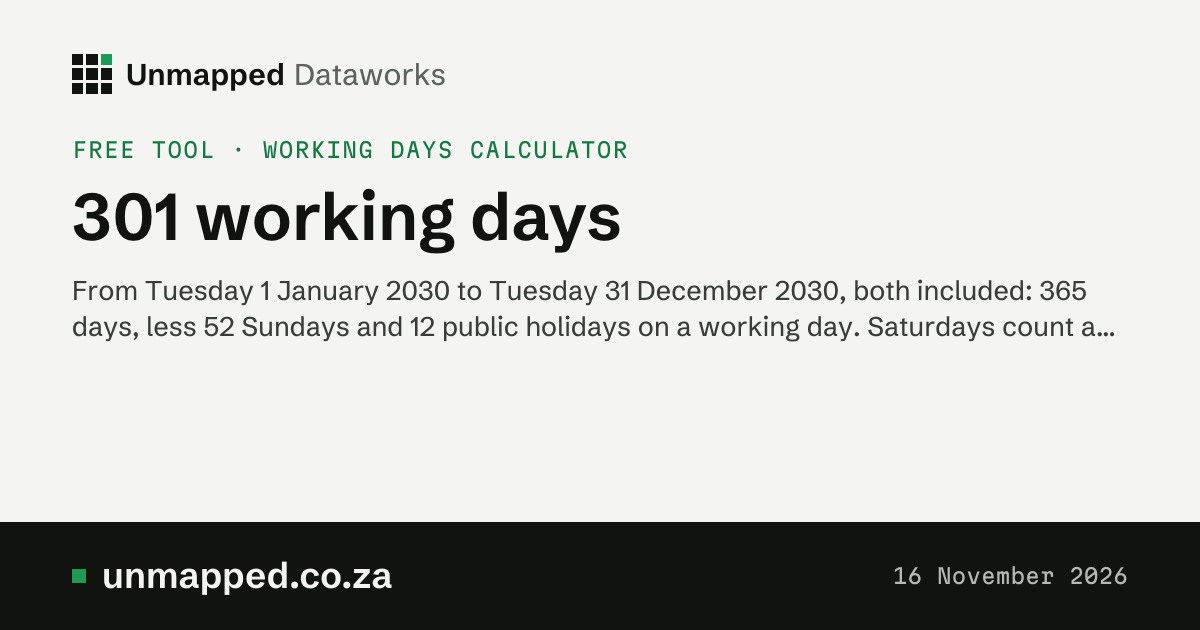
301 working days
From Tuesday 1 January 2030 to Tuesday 31 December 2030, both included: 365 days, less 52 Sundays and 12 public holidays on a working day. Saturdays count as working days.
Share on WhatsAppSave the image
Add the public holidays to your calendar · the .ics file · every calendar feed
- 301Working daysMonday to Saturday
- 365DaysBoth dates included
- 52SundaysNot working days
- 12Public holidayson working days, of 13
In a five-day week it’s 250 working days. See that count.
Public holidays in these dates
| Date | Public holiday |
|---|---|
| 1 JanuaryTuesday | New Year’s Day |
| 21 MarchThursday | Human Rights Day |
| 19 AprilFriday | Good FridayLong weekend |
| 22 AprilMonday | Family DayLong weekend |
| 27 AprilSaturday | Freedom DayFalls on a Saturday, so it doesn’t move. |
| 1 MayWednesday | Workers’ Day |
| 16 JuneSunday | Youth DayLong weekendFalls on a Sunday, so Monday 17 June is a public holiday. |
| 17 JuneMonday | Public holiday: Youth Day observedLong weekendYouth Day falls on a Sunday, so the Monday is a public holiday. |
| 9 AugustFriday | National Women’s DayLong weekend |
| 24 SeptemberTuesday | Heritage Day |
| 16 DecemberMonday | Day of ReconciliationLong weekend |
| 25 DecemberWednesday | Christmas Day |
| 26 DecemberThursday | Day of Goodwill |
How we count
A working day here is Monday to Friday, less public holidays. Tick Saturdays for a six-day week: Saturdays then count, unless one is a public holiday. Sundays never count. Both the first and the last date are included.
Public holidays come from the Public Holidays Act: when one falls on a Sunday, the Monday after it is a holiday too, and days the President declares, such as election days, are included. A holiday on a Saturday doesn’t move, so in a five-day week it takes no working day away.
Source: the Public Holidays Act 36 of 1994 (Schedule 1 and sections 2(1) and 2A) and the President’s proclamations in the Government Gazette, checked against the government’s published lists on 7 November 2026.