2026 local election results: 138 of 212 councils hung, and what happened in your province
The full results of South Africa's 2026 local elections from the IEC's files: the national vote against 2021, every province, all eight metros, which councils have a majority and which are hung, and the record wards.
By Unmapped News · · Film, 5 min
- Film5 min, in this story. Also on TikTok.
- NumbersWorked out by code from one of our checked releases. See the sources.
- CheckedAgainst the source, by a person, before it was published. Our standards.
Everything in the film is in the story below, with the numbers and their sources.
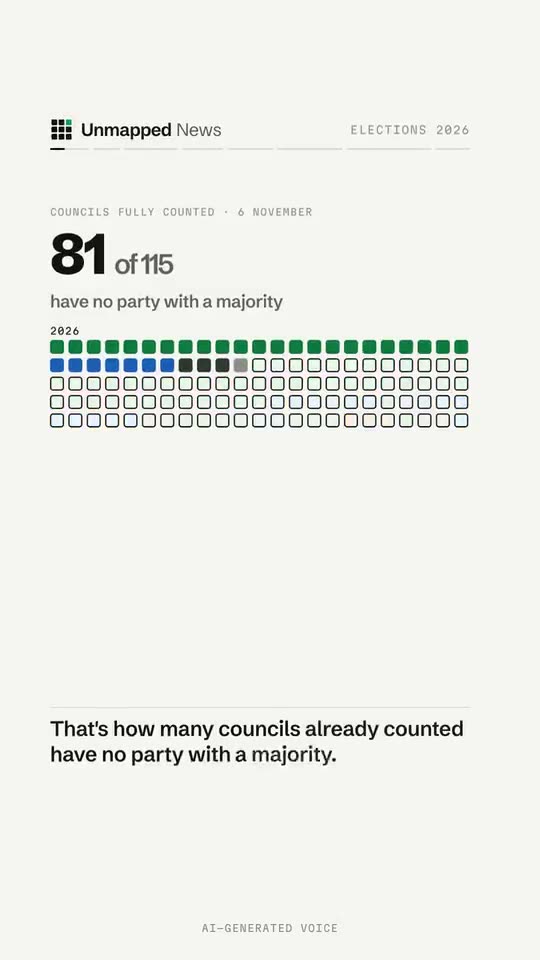
South Africa voted for its councils on 4 November 2026. If you live in one of the 138 councils where no party won more than half the seats, the people who run your town, and its budget, rates and water, will be chosen by a coalition. In 2021 that was 70 councils.
- 138councils with no party in charge, of 212 declared (70 in 2021)
- 30.8%for the ANC nationally, down 14.8 points on 2021
- 24.6%for the DA, up 3.0 points
A hung council is one where no party has more than half the seats. To pass a budget or elect a mayor, parties have to agree with each other. This was the year that became normal in South African local government.
The country
Across every council, ward and PR votes together, the ANC took 30.8%, down 14.8 points on 2021. It is its lowest share in any local election since 2000, and its biggest fall from one election to the next. The DA took 24.6%, up 3.0 points. MK, on the ballot for its first local election, took 9.8%, the EFF 6.2% (down 4.1 points), and the IFP 4.7%.
Share of the vote, 2021 and 2026
Show the numbers
| 2026 | 2021 | Change (points) | |
|---|---|---|---|
| ANC | 30.8% | 45.6% | −14.8 points |
| DA | 24.6% | 21.7% | +3.0 points |
| MK | 9.8% | 0.0% | +9.8 points |
| EFF | 6.2% | 10.3% | −4.1 points |
| ActionSA | 5.7% | 2.3% | +3.3 points |
| IFP | 4.7% | 5.6% | −0.9 points |
| FF Plus | 3.0% | 2.3% | +0.7 points |
| Communist Party | 2.4% | 0.0% | +2.4 points |
The ANC's share in every local election since 2000:
The ANC's national share in local elections
Show the numbers
| 2000 | 59.4% |
|---|---|
| 2006 | 64.8% |
| 2011 | 62.0% |
| 2016 | 53.9% |
| 2021 | 45.6% |
| 2026 | 30.8% |
Who runs the councils
Of 212 councils the IEC has declared, 74 have a party with a majority: the ANC 53, the DA 12, the IFP 5, MK 3 and Rise Tsantsabane Communities 1. In 2021 it was 143: the ANC 122, the DA 12 and the IFP 9. The ANC lost its majority in 69 councils it controlled outright in 2021.
The other 138 are hung. The party that came first in them: the ANC 79, the DA 22, MK 18, the IFP 15, the SDP 1, ICOSA 1, ActionSA 1 and the Patriotic Alliance 1.
| Party | Majorities 2026 | 2021 | First in a hung council | 2021 |
|---|---|---|---|---|
| ANC | 53 | 122 | 79 | 47 |
| DA | 12 | 12 | 22 | 13 |
| MK | 3 | 0 | 18 | 0 |
| IFP | 5 | 9 | 15 | 8 |
| Rise Tsantsabane Communities | 1 | 0 | 0 | 0 |
| SDP | 0 | 0 | 1 | 0 |
| ICOSA | 0 | 0 | 1 | 0 |
| ActionSA | 0 | 0 | 1 | 0 |
| Patriotic Alliance | 0 | 0 | 1 | 0 |
Every council, province by province
The eight metros
The metros are where most people live, and where most of the money is. 7 of the 8 have no party with a majority. In City of Johannesburg, City of Tshwane, Ekurhuleni and eThekwini, a different party came first than in 2021.
| Metro | First | Share | 2021 | Council |
|---|---|---|---|---|
| City of Johannesburg | DA | 34.8% | 26.1% | Hung |
| City of Tshwane | DA | 34.4% | 32.0% | Hung |
| Ekurhuleni | DA | 30.7% | 28.7% | Hung |
| City of Cape Town | DA | 56.4% | 58.3% | Majority |
| eThekwini | MK | 38.3% | new | Hung |
| Nelson Mandela Bay | DA | 44.2% | 39.9% | Hung |
| Buffalo City | ANC | 41.9% | 59.4% | Hung |
| Mangaung | ANC | 33.9% | 50.6% | Hung |
City of Johannesburg
The DA came first with 34.8%, up 8.6 points on 2021, ahead of the ANC on 20.3% and ActionSA on 16.3%. No party has a majority: the mayor will come from a coalition. In 2021 the ANC came first, with 33.6%.
City of Tshwane
The DA came first with 34.4%, up 2.3 points on 2021, ahead of ActionSA on 22.1% and the ANC on 20.2%. No party has a majority: the mayor will come from a coalition. In 2021 the ANC came first, with 34.6%.
Ekurhuleni
The DA came first with 30.7%, up 2.0 points on 2021, ahead of the ANC on 22.1% and ActionSA on 18.5%. No party has a majority: the mayor will come from a coalition. In 2021 the ANC came first, with 38.2%.
City of Cape Town
The DA came first with 56.4%, down 1.9 points on 2021, ahead of the ANC on 14.0% and the Patriotic Alliance on 3.8%. The DA has a majority on the council.
eThekwini
MK came first with 38.3%, ahead of the DA on 25.5% and the ANC on 16.4%. No party has a majority: the mayor will come from a coalition. In 2021 the ANC came first, with 42.1%.
Nelson Mandela Bay
The DA came first with 44.2%, up 4.3 points on 2021, ahead of the ANC on 25.5% and the EFF on 5.6%. No party has a majority: the mayor will come from a coalition.
Buffalo City
The ANC came first with 41.9%, down 17.5 points on 2021, ahead of the UDM on 18.4% and the DA on 16.9%. No party has a majority: the mayor will come from a coalition.
Mangaung
The ANC came first with 33.9%, down 16.7 points on 2021, ahead of the DA on 33.5% and the EFF on 8.6%. No party has a majority: the mayor will come from a coalition.
Province by province
In Gauteng and KwaZulu-Natal, a different party came first than in 2021.
| Province | First | ANC | ANC 2021 | Hung councils |
|---|---|---|---|---|
| Gauteng | DA, 33.9% | 21.6% | 36.1% | 8 of 9 |
| KwaZulu-Natal | MK, 34.4% | 20.3% | 41.4% | 34 of 44 |
| Western Cape | DA, 54.0% | 14.7% | 20.4% | 16 of 25 |
| Eastern Cape | ANC, 46.1% | 46.1% | 63.0% | 12 of 32 (1 counting) |
| Limpopo | ANC, 54.4% | 54.4% | 68.3% | 10 of 22 |
| Mpumalanga | ANC, 43.7% | 43.7% | 59.3% | 14 of 17 |
| North West | ANC, 44.1% | 44.1% | 55.4% | 11 of 18 |
| Free State | ANC, 37.1% | 37.1% | 50.6% | 15 of 19 |
| Northern Cape | ANC, 41.6% | 41.6% | 50.6% | 18 of 26 |
Gauteng
The DA came first with 33.9% (28.7% in 2021), then the ANC with 21.6% (36.1%) and ActionSA with 16.9% (9.4%).
Of its 9 councils: 8 are hung (8 in 2021), and 1 has a party with a majority (the DA 1), against 1 in 2021.
KwaZulu-Natal
MK came first with 34.4%, its first local election, then the ANC with 20.3% (41.4%) and the IFP with 20.1% (24.2%).
Of its 44 councils: 34 are hung (21 in 2021), and 10 have a party with a majority (the IFP 5, MK 3, the ANC 1 and the DA 1), against 23 in 2021.
Western Cape
The DA came first with 54.0% (54.2% in 2021), then the ANC with 14.7% (20.4%) and the Patriotic Alliance with 7.4% (2.4%).
Of its 25 councils: 16 are hung (16 in 2021), and 9 have a party with a majority (the DA 9), against 9 in 2021.
Eastern Cape
The ANC came first with 46.1% (63.0% in 2021), then the DA with 18.1% (15.3%) and the Communist Party with 6.3%.
Of its 33 councils, 32 have finished counting: 12 are hung (3 in 2021), and 20 have a party with a majority (the ANC 19 and the DA 1), against 30 in 2021.
Limpopo
The ANC came first with 54.4% (68.3% in 2021), then the EFF with 11.2% (14.3%) and the DA with 8.2% (5.5%).
Of its 22 councils: 10 are hung (2 in 2021), and 12 have a party with a majority (the ANC 12), against 20 in 2021.
Mpumalanga
The ANC came first with 43.7% (59.3% in 2021), then the DA with 14.6% (11.7%) and the EFF with 10.4% (15.2%).
Of its 17 councils: 14 are hung (3 in 2021), and 3 have a party with a majority (the ANC 3), against 14 in 2021.
North West
The ANC came first with 44.1% (55.4% in 2021), then the DA with 14.3% (11.4%) and the EFF with 12.5% (16.5%).
Of its 18 councils: 11 are hung (3 in 2021), and 7 have a party with a majority (the ANC 7), against 15 in 2021.
Free State
The ANC came first with 37.1% (50.6% in 2021), then the DA with 27.6% (18.8%) and the EFF with 8.2% (12.4%).
Of its 19 councils: 15 are hung (4 in 2021), and 4 have a party with a majority (the ANC 4), against 15 in 2021.
Northern Cape
The ANC came first with 41.6% (50.6% in 2021), then the DA with 21.7% (20.0%) and the EFF with 9.2% (10.5%).
Of its 26 councils: 18 are hung (10 in 2021), and 8 have a party with a majority (the ANC 7 and Rise Tsantsabane Communities 1), against 16 in 2021.
The wards
Every ward elects its own councillor. The biggest win was in ward 15 of uMdoni (KwaZulu-Natal), where the DA took 93.4% of the vote. The ANC's best was 91.0%, in ward 19 of Intsika Yethu.
In ward 7 of Mnquma, the ANC and the EFF finished level, on 366 votes each. It was one of 4 wards with a tie at the top. The IEC hadn't declared that ward when we published, which is why Mnquma's council isn't in the counts above.
25 wards were won by independent candidates.
What happens next
A new council has to meet within 14 days of the result being declared, to elect its speaker, mayor and committees (Municipal Structures Act, section 29). In a hung council that means a coalition, or a minority government that wins votes one at a time. A council that can't pass a budget can be dissolved and sent back to the voters.
Check yours
- Your municipality: its 2026 result, wards, electricity bill and water quality.
- Which ward am I in?: search for your street or suburb.
- The live tracker: every council as the IEC counted it.