Same power, double the price: why your address sets your electricity bill
The story behind our film: why towns charge so differently for the same electricity, the monthly fees that hit small users hardest, and who went up most this year.
By Unmapped News · · Film, 3 min
- Film3 min, in this story. Also on TikTok.
- NumbersWorked out by code from official files. See the sources.
- CheckedAgainst the source, by a person, before it was published. Our standards.
Everything in the film is in the story below, with the numbers and their sources.
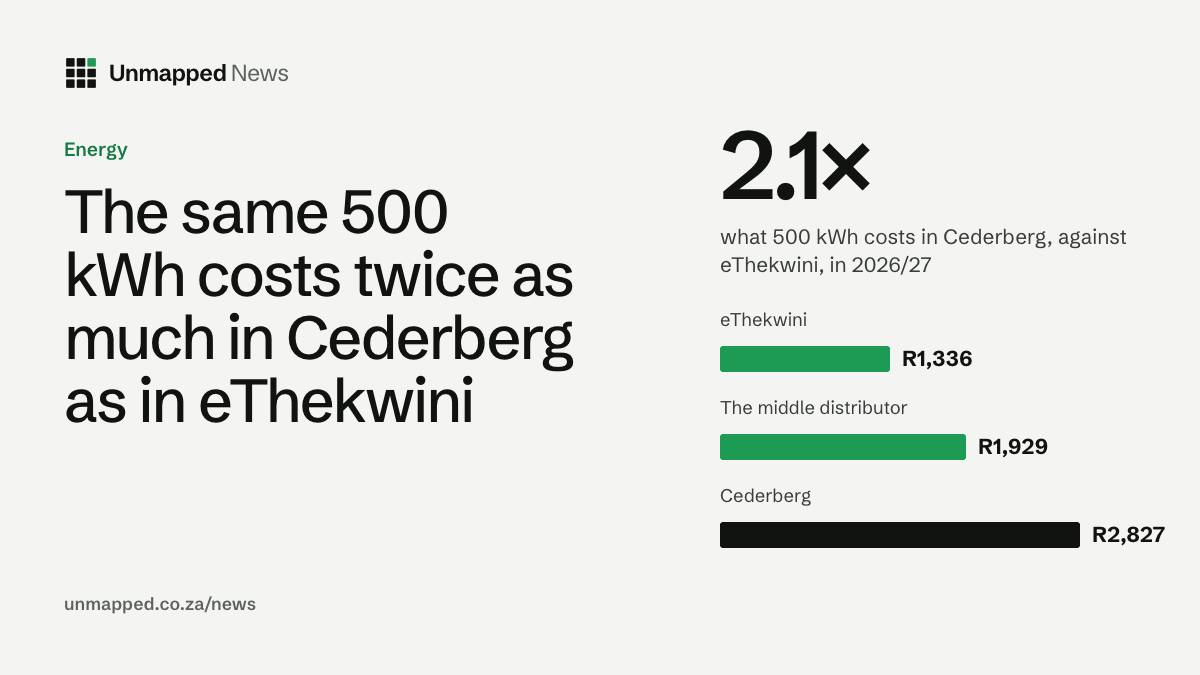
Two homes use the same electricity this month: 500 units. In eThekwini the bill is R1,336. In Cederberg, on the West Coast, it's R2,827, 2.1 times as much. The only difference is the address.
We priced that same month on every household tariff NERSA approved for 2026/27 that we have captured: 160 suppliers, prepaid, VAT included. The full ranking is in our post on what 500 kWh costs. This is the story behind it.
- R1,336Cheapest: eThekwini
- R2,827Dearest: Cederberg
- R1,910The middle bill, of 160
Why the same power costs so differently
Most municipalities buy their electricity in bulk from Eskom and sell it on to you. This July, Eskom's price to them went up 9.01%. Each town then adds its own costs: staff, repairs and the upkeep of its own network. And some power is never paid for at all: in 2024-25, municipalities lost R21.6 billion worth of electricity, the Auditor-General says.
The result is a wide spread. Half of all the bills we priced land between R1,732 and R2,142, but the extremes are far apart, and they cluster: 4 of the six cheapest are in KwaZulu-Natal, and 5 of the six dearest are in the Western Cape.
The six cheapest and six dearest bills for 500 kWh
Show the numbers
| eThekwini, KwaZulu-Natal | R1,336 |
|---|---|
| Msunduzi, KwaZulu-Natal | R1,400 |
| City of uMhlathuze, KwaZulu-Natal | R1,423 |
| Inkosi Langalibalele, KwaZulu-Natal | R1,437 |
| Kgatelopele, Northern Cape | R1,441 |
| Emthanjeni, Northern Cape | R1,471 |
| Cederberg, Western Cape | R2,827 |
| Ndlambe, Eastern Cape | R2,790 |
| Bitou, Western Cape | R2,773 |
| Cape Agulhas, Western Cape | R2,763 |
| Laingsburg, Western Cape | R2,759 |
| Oudtshoorn, Western Cape | R2,752 |
The fee before you switch on a light
68 of the 160 tariffs charge a fixed amount every month, whatever you use. In Ndlambe, on the Eastern Cape coast, it's R1,304: 47% of that 500-unit bill before a single unit is counted.
Fixed fees turn the usual logic around: the less you use, the more each unit costs. A small home using 200 units a month pays R509 in Emthanjeni and R1,898 in Ndlambe. In Ndlambe, a unit costs R9.49 at 200 units a month, against R5.58 at 500. Across the country, 56 of 160 tariffs charge a small user more per unit than a bigger one.
This year's increases
On the same tariff as last year, the typical bill is up 9.5%, and half of all the rises sit between 9% and 11%. A few jumped much more: Kareeberg by 30.9%, Thaba Chweu by 28.9% and Prince Albert by 25.3%.
The biggest increases on the same tariff
Show the numbers
| Kareeberg, Northern Cape | 30.9% |
|---|---|
| Thaba Chweu, Mpumalanga | 28.9% |
| Prince Albert, Western Cape | 25.3% |
| Ekurhuleni, Gauteng | 18.4% |
| Ditsobotla, North West | 18.4% |
Only one supplier got cheaper: Kgatelopele, down 8.5%. But only in summer. In winter, the same month costs R1,890. It isn't alone in that: 20 of 160 tariffs charge more in winter, like Beaufort West, where the same month costs R1,889 in summer and R2,544 in winter.
What's missing
Johannesburg isn't in yet: City Power is still waiting for its 2026/27 decision. We'll add it as soon as it's published.
Your own bill depends on your use, your meter and your tariff. Price yours, line by line, against last year.